
Mention the name “Vincent” in certain circles, and you either conjure up visions of one-eared Dutch post-Impressionist painter Vincent Van Gogh, John Travolta’s character Vincent Vega from Quentin Tarantino’s chronologically out-of-order crime drama “Pulp Fiction,” or, if you’re a bike guy like me—especially someone with an interest in classic motorcycles—the name “Vincent” brings to mind Vincent Motorcycles. “Makers of the world’s fastest motorcycles,” the company was founded by Philip Vincent in 1928 with Australian Phil Irving joining Vincent as an engineer in late 1931.
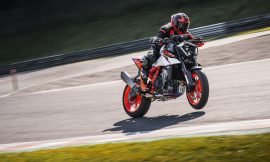
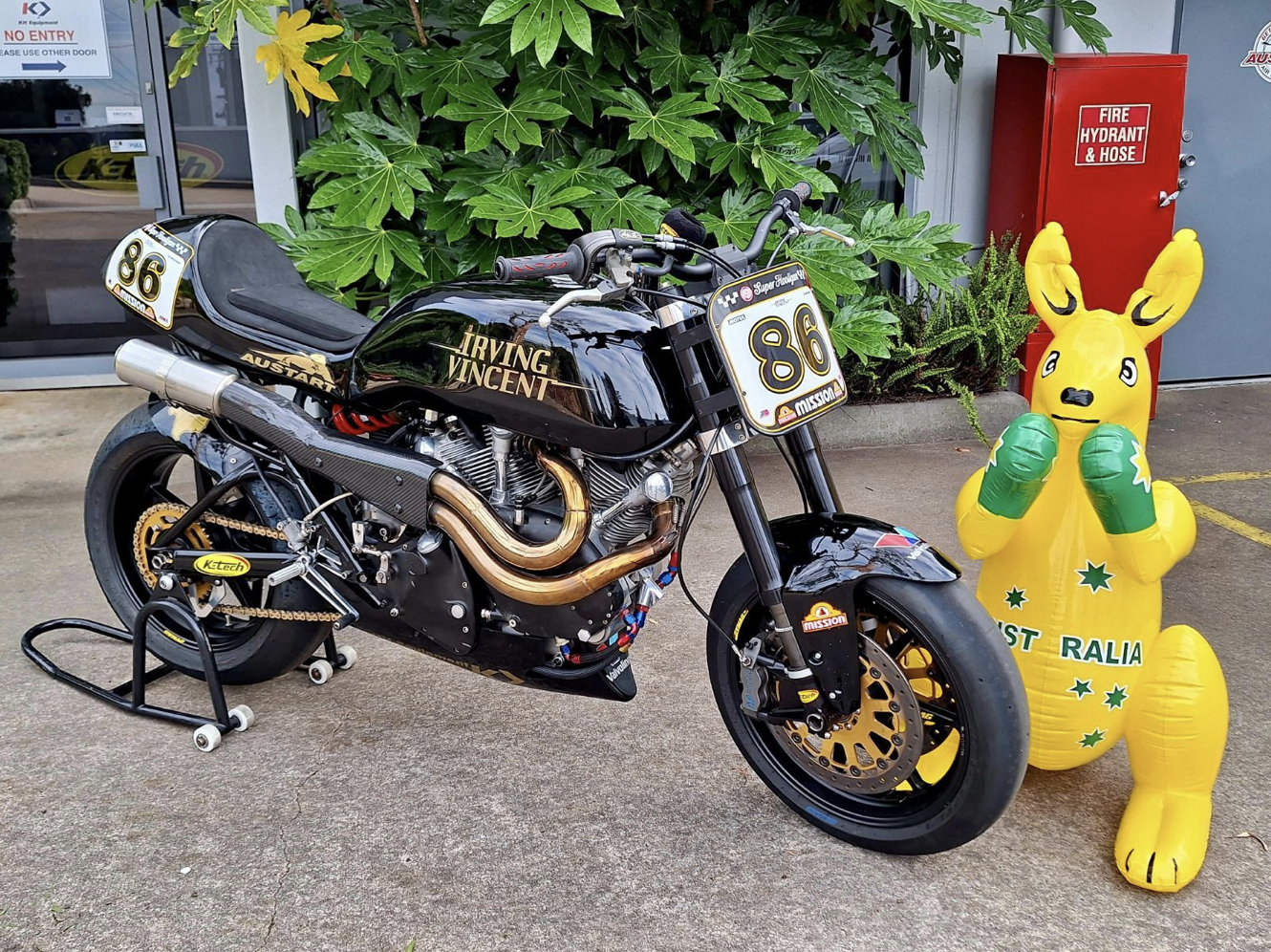
This March, “Vincent” and “Irving,” or more accurately, “Irving Vincent” will make their debut in the Mission Super Hooligan National Championship at Daytona International Speedway at the opening round of the 2026 MotoAmerica AMA/FIM North American Road Racing Championship.
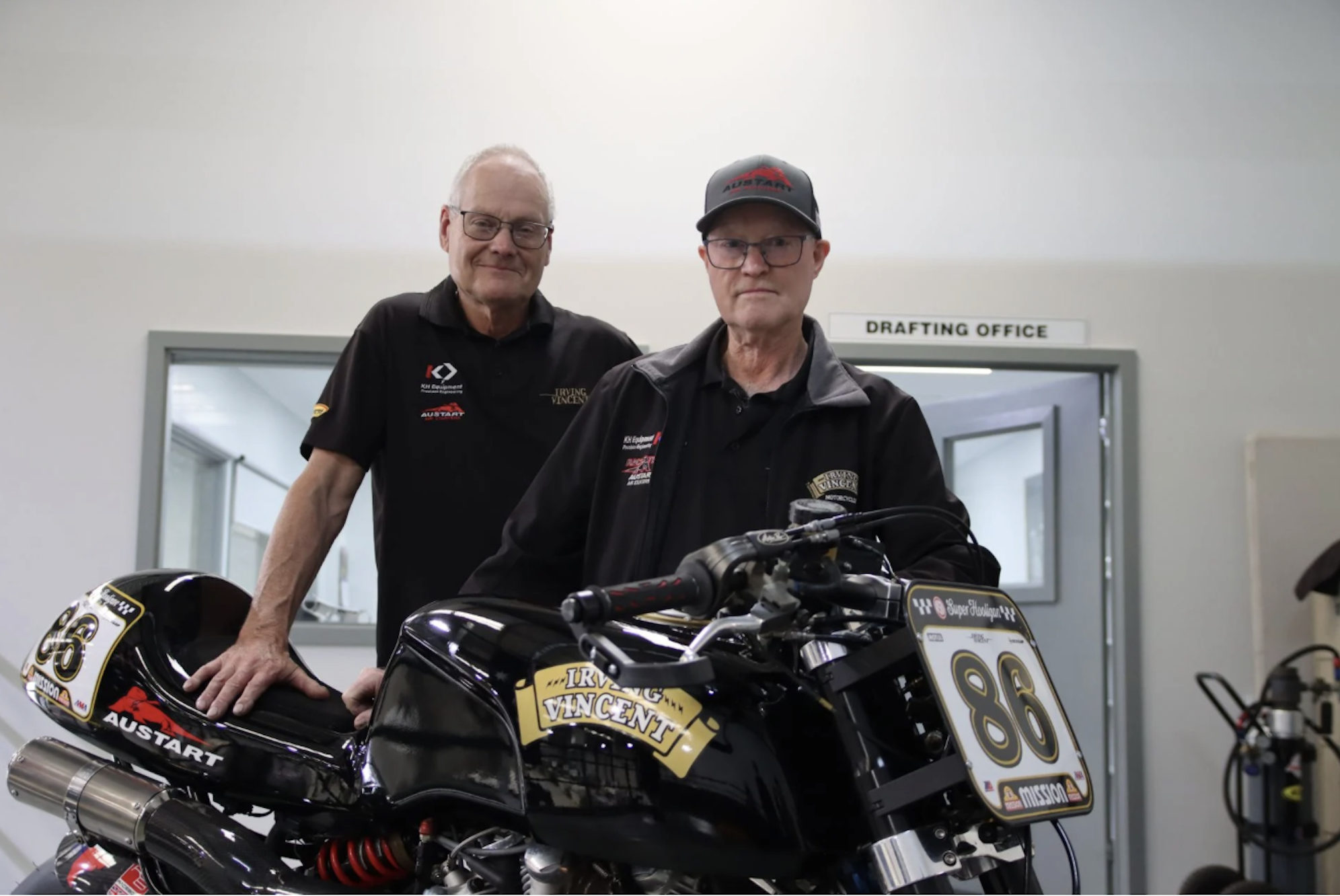
Australians Ken and Barry Horner struck up a friendship with Irving after he moved back to Australia in 1949, and both Horner brothers were successful in sidecar racing with their self-built machines using a 1300cc Vincent motor.
Ken retired from racing in 1977 to start his own engineering company, and he was later joined by Barry. Today, K.H. Equipment manufactures Austart air starters, which are used in mining, fuel exploration, and other hazardous environments where sparkless engine and equipment starting is required. These precision-machined assemblies are created on the company’s impressive array of technologically advanced CNC machines.
The Horner brothers have also continued with their passion for Vincent motorcycles, including the bespoke creation of Irving Vincent race bikes that are based faithfully on Vincent Engineers (Stevenage) Ltd.’s air-cooled, pushrod, 50-degree V-twin engine.
In 2014, the Horner brothers traveled to England with riders Australian riders Craig McMartin and Beau Beaton, and they outperformed the world’s best British Classic road racers in the prestigious Goodwood Revival on a genuine, girder-forked, 1948 Vincent Series B Rapide, which the Horners purchased and developed into a race-winning bike.
They went on to win two successive Australian Superbike Series Pro Twins Championships in 2015 and 2016 with Beaton racing a fuel-injected, air-cooled, four-valve, 1600cc version of their bike and defeating liquid-cooled bikes from Ducati, Aprilia, and KTM.
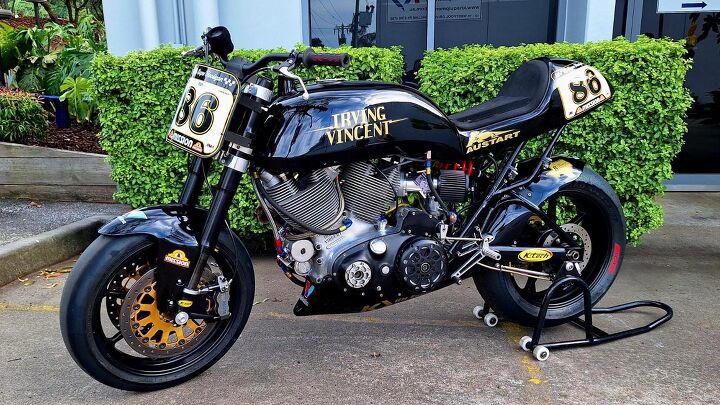
For Daytona this coming March, their air-cooled Irving Vincent Super Hooligan bike will have an engine displacement of 1622cc with just two valves per cylinder instead of four. “We need to be conservative,” Ken Horner said. “The two-valve setup can withstand more heat than the four-valve. However, we do intend to take two different bikes to Daytona.” Since there is no engine-displacement limit for Super Hooligan, the Horner brothers are also building a new, two-valve, 1760cc engine.
OK, I know what you’re thinking: an air-cooled motorcycle with just two valves per cylinder operated by pushrods is seemingly archaic, especially for the unforgiving high banks at Daytona International Speedway. After all, the existing 1622cc Super Hooligan engine is a faithful re-creation of the 50º V-twin, high-cam, overhead-valve, dry-sump, plain-bearing-crank, Vincent powerplant.
Well, perhaps a brisk summary of the Irving Vincent’s technical specs will make you think differently. It sure did me.
To start with, the Irving Vincent 1622cc Super Hooligan bike features Carrillo steel connecting rods and Nikasil-bore cylinders filled with full-skirt, three-ring, flat-top pistons that are designed in-house by the Horner brothers and custom-made by JE Pistons in California.
Engine compression is 11:1, which is suitable for MotoAmerica’s spec VP race fuel. Peak torque, which is substantial at 140 pound-feet, is delivered at 5,500 rpm.
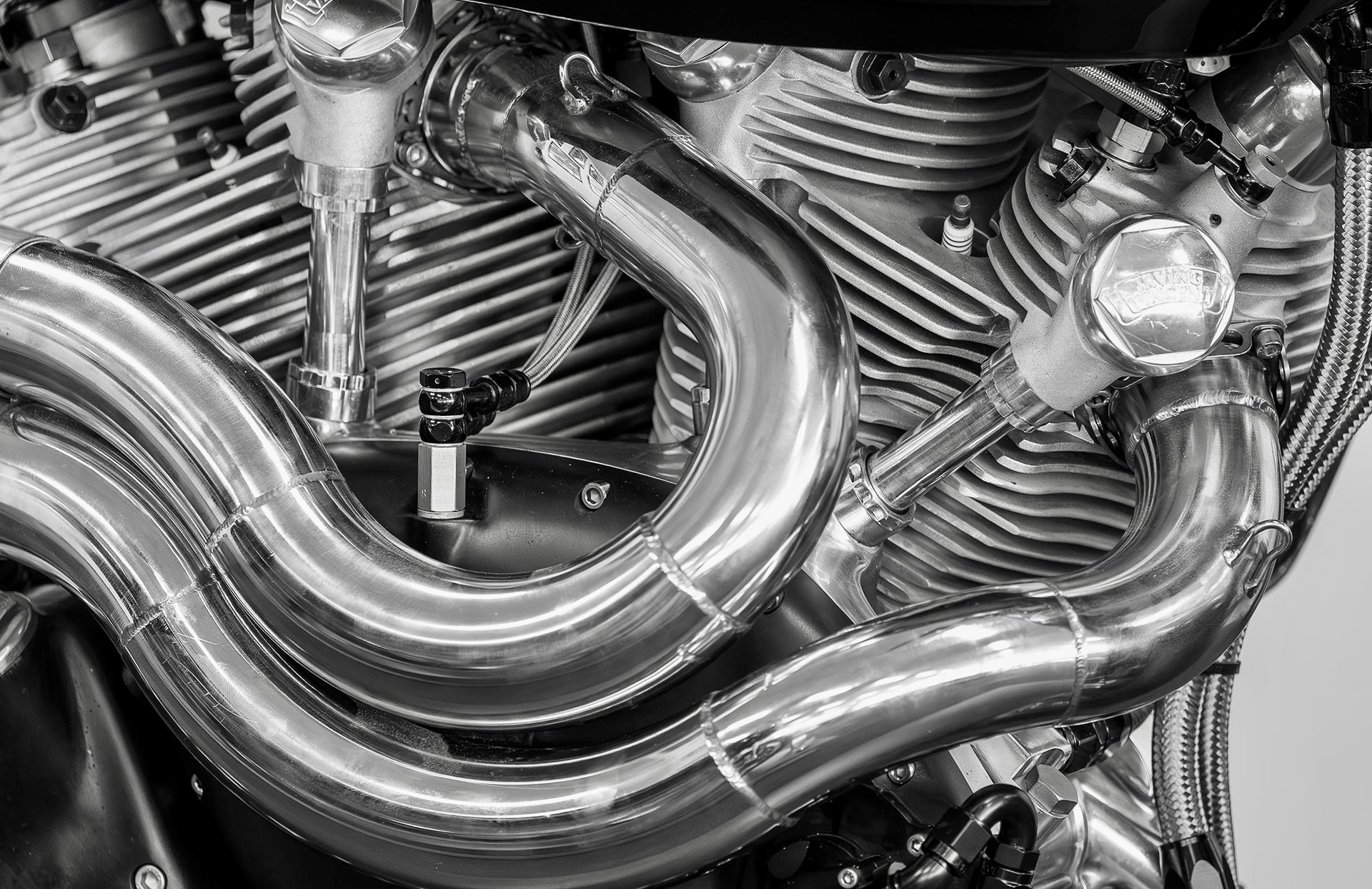
The long-stroke crankshaft weighs 18.6 pounds and is milled at K.H. Equipment from a 176-pound billet of solid steel. The two-valve, OHV cylinder heads each carry one 2.2-inch intake valve and one 1.65-inch exhaust valve, both of which are made from titanium and utilize U.S.-made dual valve springs sourced from NASCAR suppliers.
In addition, the re-created Irving Vincent engine features short, steel pushrods; roller-bearing cam followers, lightweight steel rockers, and vernier cam timing—all aimed at producing greater power more efficiently.
By the way, the roller-bearing cams were designed by Australian Eric Gaynor, an ex-Cosworth engineer who worked alongside Phil Irving at Repco-Brabham. Also, Irving designed Australia’s Formula One Repco V8 race engine that took Jack Brabham and Denny Hulme to successive F1 World Championships in 1966 and 67.
The Irving Vincent features fuel injection controlled by a MoTeC ECU. MoTeC is Australia’s world-class engine management company, and they’re literally located just up the road from K.H. Equipment’s factory on the outskirts of Melbourne. The ECU provides one fuel map, and the pair of two-inch throttle bodies, each with one side-mounted injector, are made in-house by K.H. Equipment.
The five-speed transmission is entirely fabricated on K.H. Equipment’s CNC equipment, but the selector mechanism, oddly enough, is sourced from a Yamaha RD350LC and matched to K.H. Equipment-made selector forks and drum. The multi-plate carbon clutch has a straight-cut gear primary drive.
The Irving Vincent’s chassis is a modern, chromoly interpretation of the original Vincent’s frame. A three-liter oil tank is incorporated into the frame, which feeds lubricant to the dry-sump engine.
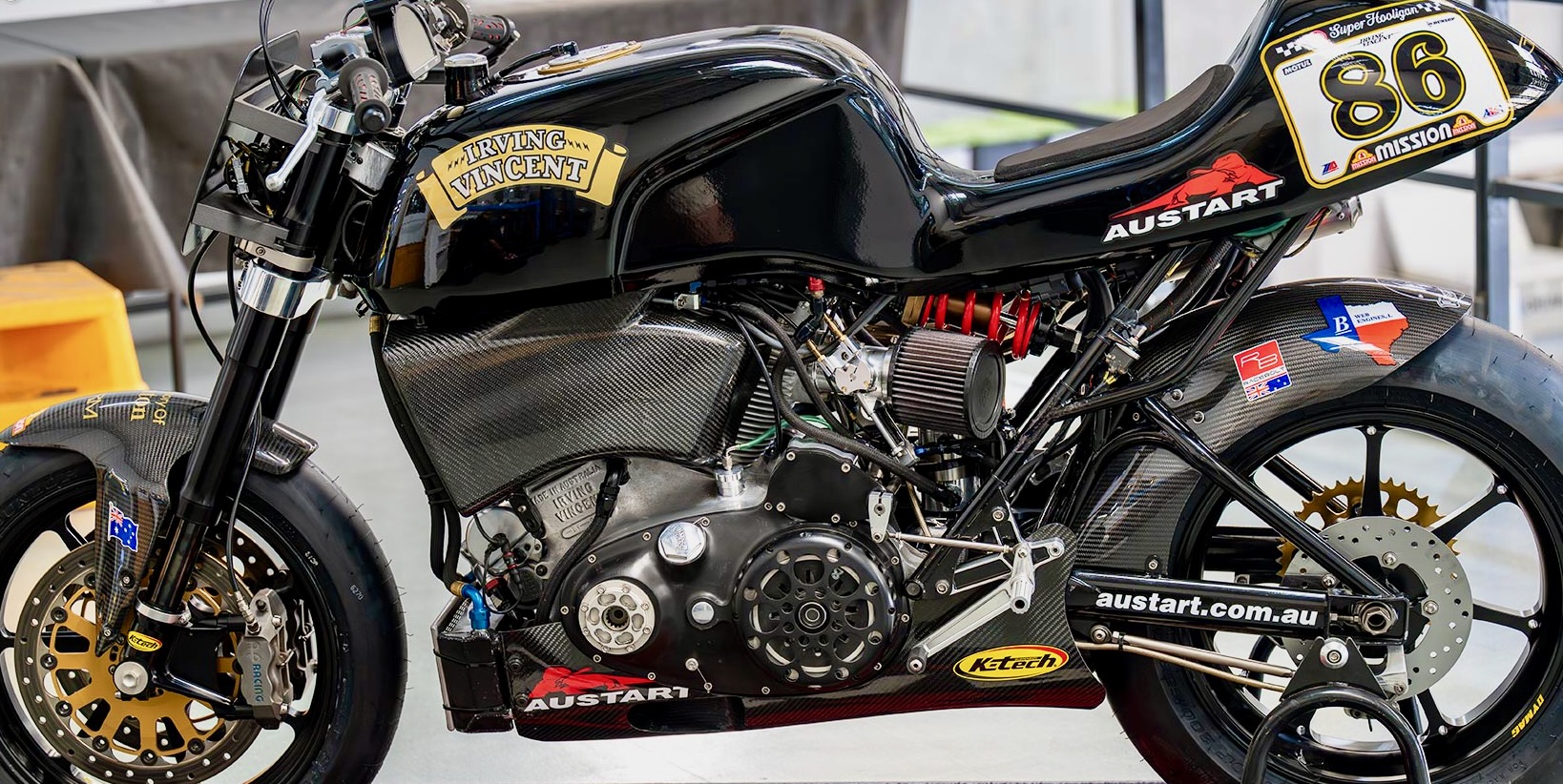
There is a fully adjustable, 43mm K-Tech KTR5 TRDS (Through Rod Damping System) inverted fork up front, and the bike’s 55.9-inch wheelbase results in a 52%/48% distribution of the Irving Vincent’s 385.8-pound dry weight. The rear suspension consists of a fully adjustable K-Tech TRDS single shock fitted to a tubular-steel, cantilever swingarm.
Incidentally, in 1928, Philip Vincent registered a patent for a cantilever swingarm of his own design, so the Irving Vincent’s rear suspension architecture also harkens back to late-1920s motorcycle know-how.
Braking is provided by twin 320mm Brembo rotors and four-piston AP-Lockheed radial calipers at the front and a 225mm Brembo rotor and four-piston AP-Lockheed radial caliper at the rear.
Forged-aluminum, 17-inch Dymag wheels are shod with a 125/80-17 Dunlop tire up front and a Dunlop 195/65-17 on the 5.5-inch rear.
So, what does Mission Super Hooligan National Championship series creator Roland Sands think about the Irving Vincent entering the fray at Daytona this March? “The Super Hooligan class was imagined as a series where special bikes would have an opportunity to race,” Sands said. “We’ve always left holes in the rules in the hopes builders would create something new or resurrect something old that could be competitive. We’re very excited to see what the Irving Vincent can do.”
Ken Horner commented, “We’ve had fantastic support from MotoAmerica, who are very keen on having us involved in the class. We’ll do our best to make a show of it, and we don’t underestimate the task ahead of us.”
A Prologue That Is An Epilogue
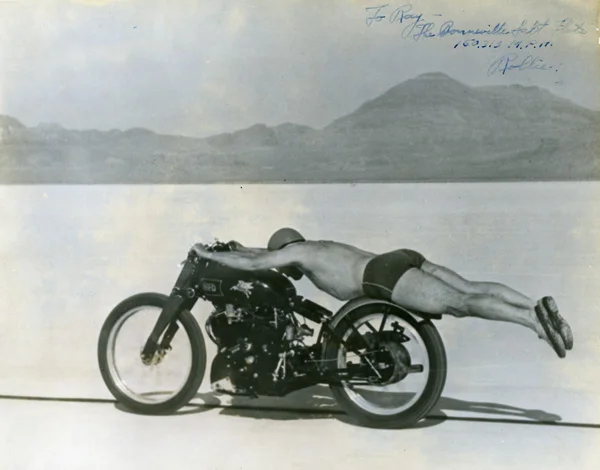
Was Rollie Free, in fact, the very first Super Hooligan rider? In 1948, wearing a pair of swimming shorts, helmet, and slippers while “planking” aboard a Vincent Black Lightning with his midsection perched on the rear fender and his legs “levitating” behind the rear wheel, Free set a new land speed record of 150.313 miles per hour at the Bonneville Salt Flats. He made two passes to claim the record.
Rollie Free’s actual first name was “Roland.” Same first name as Roland Sands. Word of caution: DO NOT refer to Mr. Sands as “Rollie.” You might get…rolled. 😉

- Sean Bice
- Sean Bice
- Sean Bice
- Sean Bice
- Sean Bice
- Sean Bice
- Sean Bice
- Sean Bice
- Sean Bice
- Sean Bice
- Sean Bice
- Sean Bice
- Sean Bice
- Sean Bice
- Sean Bice
- Sean Bice
- Sean Bice
- Sean Bice
- Sean Bice
- Sean Bice
- Sean Bice
- Sean Bice
- Sean Bice
- Sean Bice
- Sean Bice
- Sean Bice
- Sean Bice
- Sean Bice
- Sean Bice
- Sean Bice
- Sean Bice
- Sean Bice
- Sean Bice
- Sean Bice
- Sean Bice
- Sean Bice
- Sean Bice
- Sean Bice
- Sean Bice
- Sean Bice
- Sean Bice
- Sean Bice
- Sean Bice
- Sean Bice
- Sean Bice
- Sean Bice
- Sean Bice
- Sean Bice
- Sean Bice
- Sean Bice
- Sean Bice
- Sean Bice
- Sean Bice
- Sean Bice
- Sean Bice
- Sean Bice
- Sean Bice
- Sean Bice
- Sean Bice
- Sean Bice
- Sean Bice
- Sean Bice
- Sean Bice
- Sean Bice
- Sean Bice
- Sean Bice
- Sean Bice
- Sean Bice
- Sean Bice
- Sean Bice
- Sean Bice
- Sean Bice
- Sean Bice
- Sean Bice
- Sean Bice
- Sean Bice
- Sean Bice
- Sean Bice
- Sean Bice
- Sean Bice
- Sean Bice
- Sean Bice
- Sean Bice
- Sean Bice
- Sean Bice
- Sean Bice
- Sean Bice
- Sean Bice
- Sean Bice
- Sean Bice
- Sean Bice
- Sean Bice
- Sean Bice
- Sean Bice
- Sean Bice
- Sean Bice
- Sean Bice
- Sean Bice
- Sean Bice
- Sean Bice
- Sean Bice
- Sean Bice
- Sean Bice
- Sean Bice
- Sean Bice
- Sean Bice
- Sean Bice
- Sean Bice
- Sean Bice
- Sean Bice
- Sean Bice
- Sean Bice
- Sean Bice
- Sean Bice
- Sean Bice
- Sean Bice
- Sean Bice
- Sean Bice
- Sean Bice
- Sean Bice
- Sean Bice
- Sean Bice
- Sean Bice
- Sean Bice
- Sean Bice
- Sean Bice
- Sean Bice
- Sean Bice
- Sean Bice
- Sean Bice
- Sean Bice
- Sean Bice
- Sean Bice
- Sean Bice
- Sean Bice
- Sean Bice
- Sean Bice
- Sean Bice
- Sean Bice