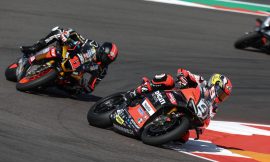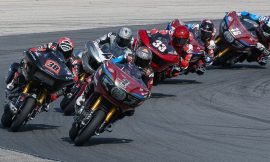

As the riders took their positions on the starting grid, the air was charged with excitement and expectation. Everyone in the Speedway had his or her own idea of which rider or riders to watch, and most of the fans had already picked the winner before the race even started.
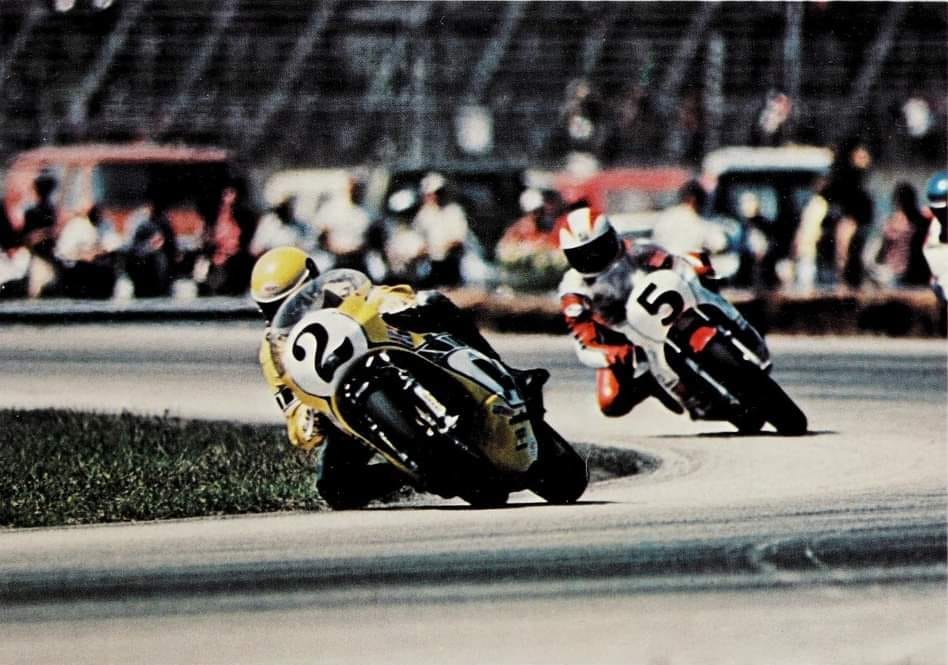
In 1976, the crystal-gazers and oddsmakers chose Kenny Roberts as the rider most likely to win the Daytona 200. Although something had always kept the California rider from victory in the past, most of the experts felt that 1976 was finally Roberts’ year for a Daytona 200 win. There were several factors tipping the scales in Roberts’ favor. First, there was the fact that he had been the fastest of all 80 qualifiers in the race. What’s more, he had set a new lap record at Daytona, qualifying with an average speed of 111.456 mph. Then there was Roberts’ superb winning performance in the 100-mile Lightweight Expert race, held the day before on 250cc machines. After winning the event for the third year in a row, even Roberts was optimist about the upcoming 200-mile race. “I feel if I can finish (the Daytona 200) with a healthy bike, I can win,” he said.
But, while Roberts was the odds-on favorite in 1976, there was a roster of other able-bodied contenders who were ready to step into the breach should Roberts or his Yamaha falter for just an instant.
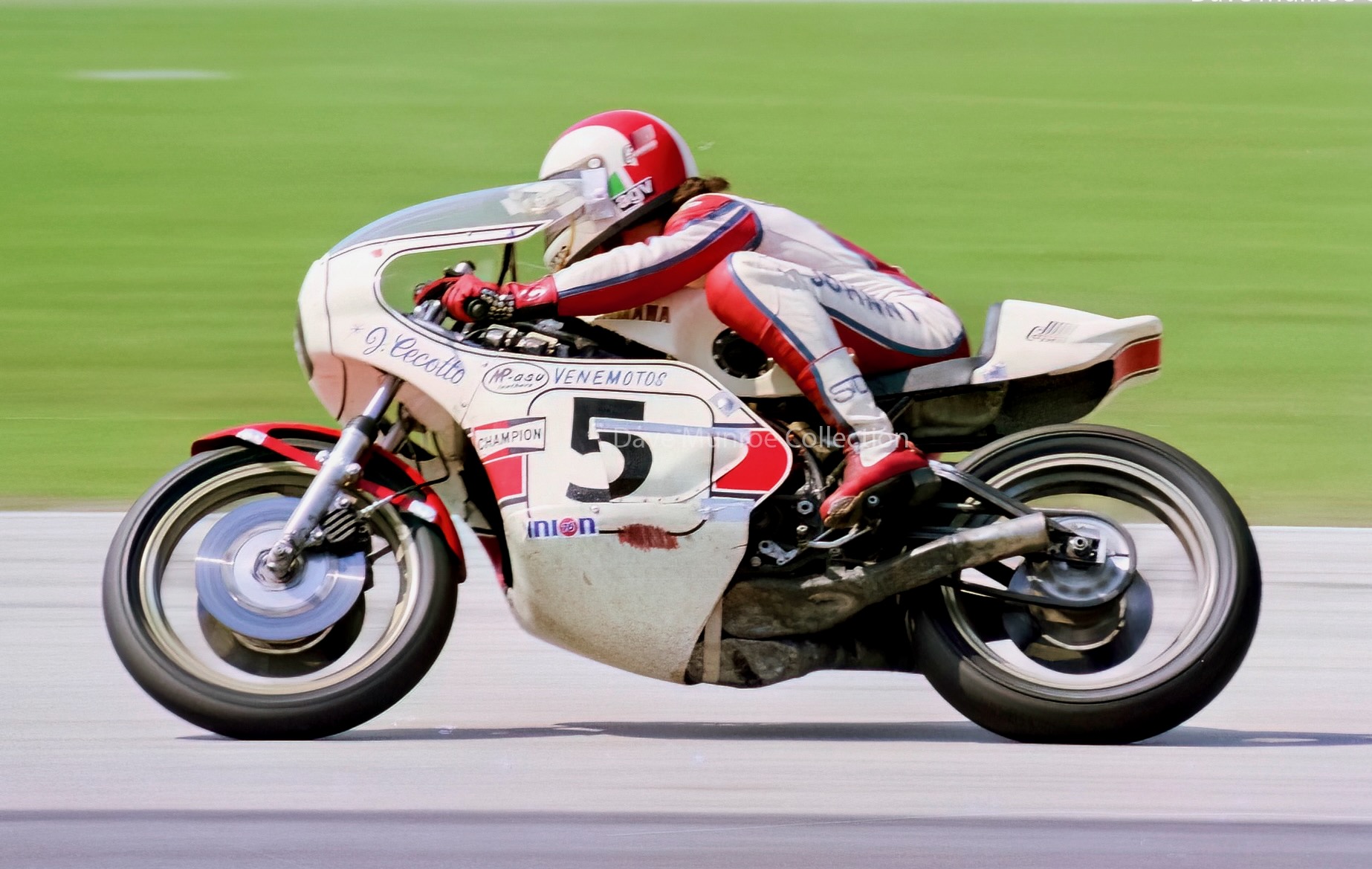
Running neck and neck with Roberts, predicted the experts, would be Johnny Cecotto of Venezuela, the reigning 350cc Grand Prix World Champion. Other strong contenders behind frontrunners Roberts and Cecotto included Steve Baker and Hideo Kanaya, both of whom had qualified on the front row aboard Yamaha motorcycles, along with talented newcomer Pat Hennen, defending Daytona 200 champion Gene Romero, and perennial racing favorite Gary Nixon, who had won the Daytona 200 nine years earlier in 1967.
By the time the 1976 Daytona 200 came to its thrilling conclusion, three of the leading contenders would be standing in Victory Circle, and one of them would be on the top step of the podium.
A Three-Act Play
If Daytona Bike Week has been likened to a three-ring circus, then the Daytona 200 is like a three-act play. It has three distinct parts or segments: the start (act one), the pit stops (act two), and the checkered flag (act three). Although the basic format of the race is the same from year to year, each year brings a new audience (the spectators) and a new cast of characters (the riders). More importantly, each year brings a brand-new “script” filled with drama and suspense, charged with action and excitement, and loaded with surprises. The 1976 Daytona 200 was no exception.
Act One
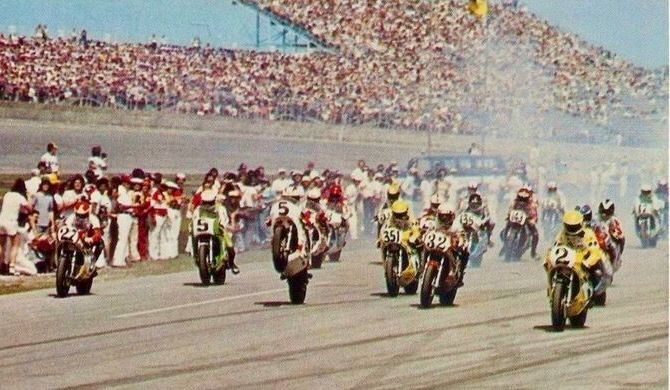
In the view of most riders and race fans, the start of the Daytona 200 is easily the most colorful, exciting, and emotionally supercharged part of the “Great American Motorcycle Race.”
As they awaited the starting signal, the 80 entrants in the 1976 Daytona 200 were lined up in 16 rows, five riders per row, positioned in the order in which they qualified. Instead of taking off at the same time, they’re flagged off in three separate waves of 30, 30, and 20 riders each. The staggered start is used for safety’s sake, so that, if a rider has a tipover in the first turn, he or she won’t take the whole field down with them (if all 80 riders were allowed to head into the first turn at the same time, one downed rider could trigger a disastrous chain reaction, turning the start of the race into a nightmare). Even with the safety precaution of a staggered start, the first turn is still one of the most perilous sections of the entire race course. As the riders roar away from the starting line, they are bunched so tightly together that they risk bumping into one another as they battle for position and head into the first turn. With 30 riders all trying to get through the first turn at the same time, one rider’s miscue can cause several contestants to fall – one into the other – like a set of dominoes. So, the riders must be extremely careful as they negotiate the first turn of the Daytona 200, where a pileup has dashed the hopes of many a contender.
During the start of the 1976 Daytona 200, polesitter Kenny Roberts was hopeful of letting someone else set the pace for the first leg of the 200-mile race. But, everyone held back at first, reluctant to take the lead, and no one seemed willing to set the pace. Although Johnny Cecotto led through the first lap, it was Roberts who went to the head of the pack on the start of the lap 2, and he maintained the lead until his first pit stop. In the process, he set a blistering pace that left almost all his rivals in the dust. All but Johnny Cecotto and Hideo Kanaya, both of whom were competing aboard Yamaha machines almost identical to the one Roberts was riding.
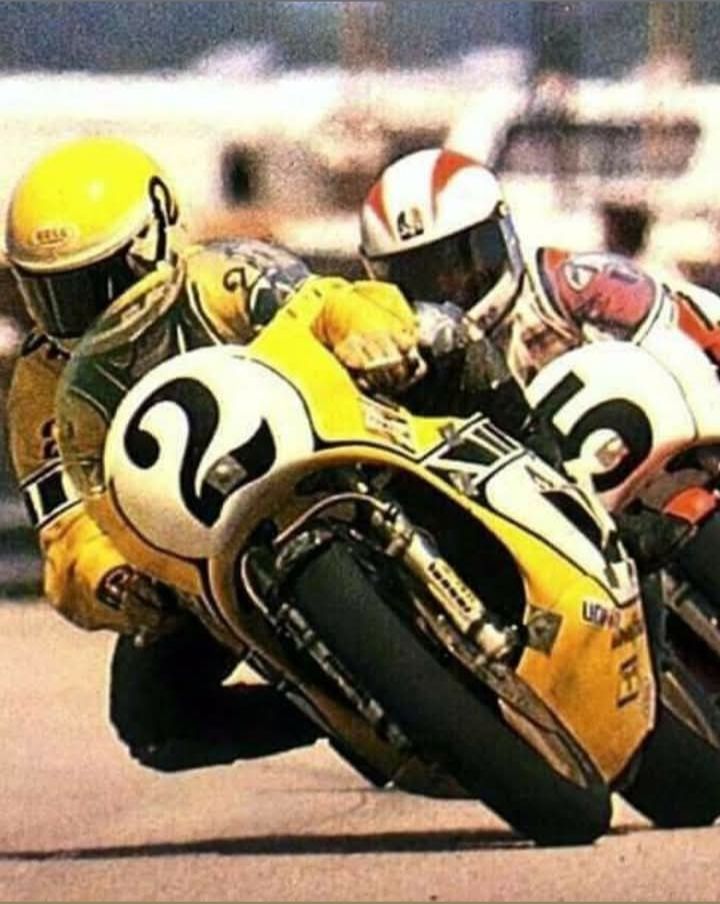
By the time Roberts completed lap 15, he had set a near-record pace of 109.816 miles per hour. Hideo Kanaya, in third place, had fallen far behind Roberts by then, with only Johnny Cecotto able to stay within reach of the American Yamaha rider.
Both Roberts and Cecotto chose to make their first pit stops on lap 16. Thanks to the lightning-fast work of his pit crew, Cecotto gained several seconds on Roberts and jumped back into the race ahead of his American competitor. But his lead was short-lived. While taking one of the speedway’s steeply banked turns, he accidentally brushed his foot against the concrete banking and twisted his ankle. When the combination of this ankle injury and a cracked exhaust pipe slowed the Venezuelan’s pace and took the edge off his lead, Roberts overtook Cecotto and regained the number-one position.
Act Two
The second act of the Daytona 200 begins somewhere between lap 16 and lap 20. The riders settle into a steady, even pace as they try to save their energy and their machines for a final charge to the finish line near the end of the race.
During Act Two of the 1976 Daytona 200, frontrunner Kenny Roberts eased up a bit, reducing his speed to maintain a comfortable lead. Yet, his pace was still much faster than most of the other riders on the racetrack. With Roberts way out in front, his only serious rival for first place was Cecotto. The Venezuelan was moving at a slower pace than Roberts, but he was still close enough to seize the lead from Roberts should the American road racing ace falter for any reason.
Roberts, however, seemed unconcerned about a possible challenge from Cecotto. As he completed lap 30, he was in total control of the race, looking like a winner all the way. All the way, that is, until the lap 32 when, incredibly, Roberts’ fifth consecutive bid for the Daytona 200 crown ended prematurely because of yet another stroke of bad luck. Roberts’ blistering pace had made him the leader of the pack, but all the hard riding had taken a terrible toll on his Yamaha’s tires, wearing them so thin that Roberts could no longer control his bike at high speeds. This forced him to slow his pace considerably in order to keep from crashing. Cecotto took advantage of his rival’s misfortune, overtook Roberts, and slipped into the lead.
Roberts struggled on gamely aboard his wobbling bike, doing his best to keep it under control. But the situation was hopeless, and the worst finally happened. One of Roberts’ tires blew out and almost caused him to crash.
Somehow, he managed to stay aboard his bike, riding on the rim of the blown-out tire. A slow trip to the pits, followed by a four-minute tire change that must have seemed like four hours to Roberts, spelled a ninth-place finish for the ill-fated rider who had been favored to win the race. And so ended Kenny Roberts’ 1976 bid for the Daytona 200.
Act Three
The Daytona 200 reaches a feverous pitch during the last few laps when the frontrunners pour on the speed in a spectacular display of hard-charging, all-out racing. If the contest is a close one, many lead changes may occur among the riders as they pass one another and do battle for favorable positions going into the final lap of the race. Once they reach the homestretch of the 200-mile spectacle, the riders race flat out. Holding nothing back, the competitors push themselves and their machines to the utmost limits as they sprint toward the checkered flag awaiting them at the finish line, where a mere fraction of a second can separate the winner of the race from the rider in second place.
Although some of the riders trailing behind Johnny Cecotto put on what could be considered a finishing sprint, they were never really in the race for first place. With no one to contest his position as the leader, Cecotto coasted home to the victory, a full lap ahead of the second-place finisher.
Luck had played a strange role in Cecotto’s victory. The injury to his ankle had forced the Venezuelan to slow his pace, but ironically, his injury-slowed pace had spared him the tire wear that had plagued Roberts and some of the other Daytona 200 riders. Yet Cecotto, too, had worn his tires dangerously thin, prompting a post-race admission that he would have pitted had he known the condition of his tires. Earlier in the race, the gritty youngster had been tempted to pull up and nurse his twisted ankle. But, luckily, he had resisted the urge and went on to win the race.
Finishing second, a lap behind Cecotto, was Gary Nixon, winner of the 1967 Daytona 200, aboard a Kawasaki. Nixon, who two years earlier had suffered a high-speed accident during a test ride in Japan, proved with his 1976 Daytona performance that he was on the comeback trail. Rounding out the victory circle trio was Pat Hennen, the young Suzuki pilot who had been the top qualifier not aboard a Yamaha.
Victory Circle
If act three of the 1976 Daytona 200 was anticlimactic, the celebration in Victory Circle more than made up for the lack of excitement in the closing moments of the race.
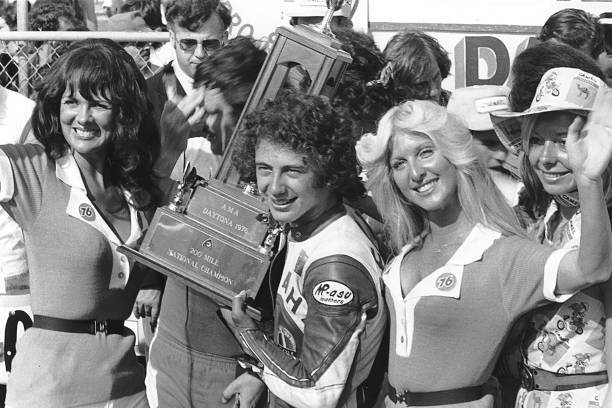
Although comprising just a small portion of the 75,000 fans who watched the race in 1976, the Venezuelan crowd filled the Speedway with roars of approval for Johnny Cecotto.
The Venezuelan fans were ecstatic that their hero had done what they had been saying he would do all week: win the Daytona 200. Some 200 strong, they seemed more like 2,000 as they swarmed past security guards, onto the track, and then into Victory Circle to congratulate Johnny Cecotto. Thousands of spectators watched as the Venezuelan fans turned what is normally a joyous celebration into a full-fledged South American fiesta.
A few understandably disappointed Roberts supporters claimed the final results had been more a matter of their hero losing than of Cecotto winning. But Cecotto’s 1976 victory was no fluke, nor was Roberts’ ninth-place finish the result of some conspiracy or plot.
It was simply another incredibly exciting and surprising Daytona 200.
1976 Daytona 200 Results
POS # RIDER BIKE
1 5 Johnny Cecotto Yamaha
2 9 Gary Nixon Kawasaki
3 40 Pat Hennen Suzuki
4 3 Gene Romero Yamaha
5 13 Patrick Pons Yamaha
6 354 Michel Rougerie Yamaha
7 351 Hideo Kanaya Yamaha
8 29 Randy Cleek Yamaha
9 2 Kenny Roberts Yamaha
10 319 John Dodds Yamaha
11 91 Bob Endicott Yamaha
12 168 Dennis Purdie Yamaha
13 346 Kenny Blake Yamaha
14 333 Alex George Yamaha
15 84 Walt Foster Yamaha
16 140 Doug Libby Yamaha
17 56 Len Fitch Yamaha
18 78 Robert Wakefield Yamaha
19 52 Kevin Stafford Yamaha
20 325 Rob Bron Yamaha
21 37 Ed Hanson Yamaha
22 342 David Potter Yamaha
23 327 Boet Van Dulmen Yamaha
24 122 Dale Singleton Yamaha
25 96 Ron Mass Yamaha
26 57 Christian Estrosi Suzuki
27 49 Steve Mallonee Yamaha
28 71 Richard Chambers Yamaha
29 152 Cory Rupplet Yamaha
30 340 Johnny Bengtsson Yamaha
31 326 Marcel Ankone Suzuki
32 25 Michael Trimby Yamaha
33 120 Henry DeGouw Yamaha
34 7 Barry Sheene Suzuki
35 6 John Newbold Suzuki
36 17 Yvon Duhamel Kawasaki
37 237 Bruce Townsend Yamaha
38 62 Bob Rectenwald Yamaha
39 50 John Long Yamaha
40 35 Wes Cooley Yamaha
41 148 Bruce Hammer Yamaha
42 166 George Miller Yamaha
43 143 Michael Clarke Yamaha
44 83 Steve McLaughlin Yamaha
45 93 Brian Henderson Yamaha
46 66 Larry Bleil Yamaha
47 24 Gary Fisher Yamaha
48 22 John Williams Suzuki
49 12 Malcolm McPherson Yamaha
50 26 Cliff Carr Yamaha
51 345 Dieter Braun Yamaha
52 146 Bruce Lind Yamaha
53 332 Alain Vial Yamaha
54 33 Jimmy Morales Yamaha
55 38 Phil Read Yamaha
56 67 John Fuchs Honda
57 328 Wil Hartog Suzuki
58 324 Gregg Hansford Kawasaki
59 132 Bill Peters Yamaha
60 118 Steve Manship Yamaha
61 316 Terry Hutton Yamaha
62 53 Ted Henter Yamaha
63 137 Gerard Choukroun Yamaha
64 178 Rich Williamson Yamaha
65 164 Whitney Blakeslee Kawasaki
66 27 Skip Aksland Yamaha
67 97 Ron Pierce Kawasaki
68 59 Tommy Byars, Jr. Yamaha
69 321 Robert Madden Yamaha
70 63 Mike Devlin Yamaha
71 32 Steve Baker Yamaha
72 371 Stephen Klein Yamaha
73 160 Alan Barbic Yamaha
74 385 Warren Willing Yamaha
75 58 Phil McDonald Yamaha
76 339 Pentti Korhonen Yamaha
77 114 Gary Blackman Yamaha
78 341 Philippe Coulon Yamaha